Training & Technical Assistance Packages
IMI is grateful for the opportunity to expand its services to better serve Native communities that are working toward educational sovereignty through Indigenous language and early child programs. To do this, we offer trainings and technical assistance depending on the respective needs of interested organizations.
All IMI trainings are intended to assist organizations in strengthening their policies, understandings, and practices around anti-racism, Indigenous Education, Indigenous language immersion and dual-language immersion, and school program development.
IMI Technical Assistance packages are designed to offer specialized one-on-one technical assistance to education programs that are aiming to transition to language immersion programs, language revitalization Montessori schools, and tribal language programs and staff.
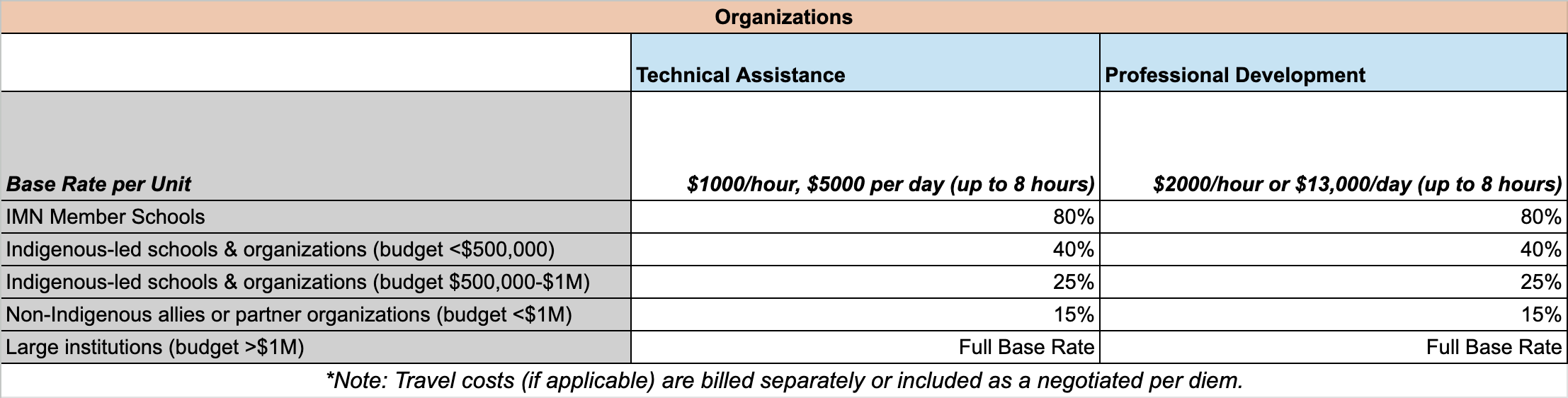
The fees for these services vary depending on the need, number of participants, and requested deliverables. IMI training staff will work with designated staff of interested organizations to determine priority areas, scheduling, and intended outcomes.
For further information about any of the above listed programs, contact Margarita Acosta at 505-418-6767 or margarita@kclcmontessori.org.
Professional Development Workshops
Professional Development Workshops will focus on the following areas:
- Anti-Biased, Anti-Racist Approaches to Education
- Culturally Sustaining Pedagogies
- Indigenous Curriculum Building
- Healing and Historical Trauma
- Language and Culture as Protective Factor
- Information sheets for each event will be posted and distributed as the date approaches. This info sheet will include cost, time, and registration info.
Indigenous Montessori Institute Professional Development Menu
- Foundations of Native Language Development and Reclamation- Early Childhood (Birth-6) and Elementary (6-12) (3 hours)
This session grounds participants in the principles of Native language immersion and dual-language education, emphasizing how language development unfolds across early childhood and elementary years. It explores taking advantage of the absorbent mind for language learning, the role of self-expression, and how Indigenous language learning nurtures identity, emotional development, and belonging.
- Foundations of Native Language Development and Reclamation- Adolescent (12-24) (3 hours)
This session explores how Native language reclamation supports adolescents in forming a strong sense of identity, purpose, and liberation. It addresses common misconceptions, the role of anti-racism, and how language learning can be a transformative act of resistance to capitalism and settler colonialism by supporting adolescents in their journey of language learning through project based learning that supports themselves as well as their communities.
- Reclaiming the Education of Our Children (3 hours)
This module dives deep into the history of Indigenous Education and policy outlining how the federal government’s-imposed education systems have disrupted Native Nations in this country. This module explores the past and current impacts of those systems and the resilience that exists within Indigenous communities to overcome and reclaim the education of Indigenous children using their Native language and culture to reground children.
- Embracing Equity (10 hours)
These modules discuss and dive into identifying and naming institutional racism and oppression and exploring how this influences our own behaviors, thoughts, and beliefs, particularly as it pertains to Native/Indigenous people and their relationship to a settler colonial government. These modules launch one into the lifelong journey of developing the personal skills to identify, check, and dismantle white supremacy culture characteristics in the educational, community and familial context starting with one’s self.
- Culturally Sustaining Pedagogies (3 hours)
This module focuses on an understanding of what Culturally Sustaining Pedagogy (CSP) is and dives even deeper to what culturally sustaining revitalizing pedagogy is and how that more aptly describes what is happening when a Native Nation reclaims the education of their children. Examples are shared as a way to help create strategies to ensure that schools and classrooms are honoring the gifts of their students, their communities and their languages by centering all aspects of Native life in an education/academic setting with the purpose of shifting power dynamics.
- Why KCLC? (3 hours)
This module describes and discusses the conditions that exist in Native Nations that have brought about the need for Native communities to do education on their own terms, such as the case with Keres Children’s Learning Center. What are the systemic structures that prevent mainstream education institutions from serving and nurturing the whole Native child without the sacrifice or compromise to Native language, identity and life ways?
- Wider World of Indian Education (3 hours) [Recording]
This module presents participants with an array of educational models that may be more suited for serving Native populations as they work to better accommodate language and culture, values, and beliefs systems. Participants will explore what is possible in Indigenous education, As sovereign Native Nations, Natives have the inherent right to govern the education of their children. Like children who live in “town” or urban areas, Native children should have the possibility of choosing an option for learning that is centered on their Native languages and cultures and not just the local Headstart, Public School and Bureau of Indian education models.
- Indigenous Language-Immersion (3 hours)
This module focuses on developing the capacity, the knowledge and skills to create a learning environment for an immersion classroom where a Native language is the target language. Participants will also acquire knowledge and skills necessary to run a true immersion setting. During this module, participants will learn the many considerations one must be mindful of when implementing an immersion classroom with regard to an Indigenous language rather than a world language.
- Indigenous Dual-Language Education (3 hours)
This first half of this module follows the lead of our Indigenous Language Immersion module by providing participants knowledge of the differences between Indigenous dual language programming versus dual language programming models for colonizing languages such as Spanish, French or Chinese. Participants will learn the importance of teaching academic content in their target language.
- Indigenous Early Childhood (3 hours)
The second half of this module defines what Indigenous Early Childhood is and the potential for it while highlighting the negative impacts of policies that still affect the wholeness of Native children in contemporary early childhood settings, especially those operating on Native Lands.
- Indigenous Knowledge Systems (3 hours)
In this module participants will explore strategies to develop curriculum from our Indigenous Knowledge Systems (IKS) which are embedded most fully in our Indigenous languages. Participants will learn how to create Indigenous and academic themes and lessons directly from their Native Nation’s IKS and with tribal/community resources i.e. language, culture, values, land based and develop academic lessons using the methods and tools provided during this module.
- Indigenous Genius by Design (3 hours)
In this module participants will explore a 3-stage curriculum design approach focused on student understanding and indicators (e.g., to explain, interpret, apply, shift perspective, empathize, and self-assess). Participants will learn how planning is best done “backward” from the desired results and the transfer tasks that embody the goals. The 3-stages (desired results, evidence, and learning plan) must align for the unit to be most effective. Participants will utilize the IGbD template to better understand purposeful curricular planning.
- Tyranny of Outcomes (3 hours)
The purpose of this module is to have participants rethink and redefine success and achievement for Native/Indigenous children. This module is about being intentional in building learning settings with educational outcomes that help to sustain Indigenous communities in all their ways of life and subtract from them. Creating educational outcomes that value Indigenous ways of being while equally valuing Western academics is addressed in this module. Being mindful of the tyranny of outcomes and not being oppressed by them helps to reinforce education sovereignty by having Native Nations determine outcomes AND the process used to reach those outcomes.
- Reclaiming the Education of Our Children (3 hours)
This module dives deep into the history of Indigenous Education and policy outlining how the federal government’s-imposed education systems have disrupted Native Nations in this country. This module explores the past and current impacts of those systems and the resilience that exists within Indigenous communities to overcome and reclaim the education of Indigenous children using their Native language and culture to reground children.
- Indigenous Early Childhood (3 hours)
The second half of this module defines what Indigenous Early Childhood is and the potential for it while highlighting the negative impacts of policies that still affect the wholeness of Native children in contemporary early childhood settings, especially those operating on Native Lands.
- Program Infrastructure of Native Language Immersion (3 hours)
This module focuses on the need to understand the container needed to hold a Native language revitalization program. Lessons learned at Keres Children’s Learning Center (KCLC) will be shared to have participants think, envision and plan what they need for their own work. What is the mission and vision of the school? Who will fund the program? What kind of organizational structure will their be? Will it be an Indigenous structure or colonial structure or both? How will you use your Tribal Nation’s Indigenous Knowledge Systems to further language revitalization work? What academic curriculum will you use to support Native language revitalization efforts?
- Native Language Immersion School Policies and Procedures (3 hours)
As we create Native language immersion programs and learning settings, having policies and procedures allows for everyone to have a shared understanding about what it takes to have these programs. Having policies and procedures are also an opportunity to think about what kind of work culture needs to be established-a work culture that is working on decolonization and indigenization. All Native Nations have protocols for ceremonies, governance, kinship systems and so on. The work of Native language revitalization is sacred AND there is also the day to day and creation of policies and procedures is another way to support the mission of any program.
- Program Elements of Native Language Immersion (3 hours)
Language immersion practices have been proven to be one of the most effective ways of revitalizing Indigenous languages. KCLC’s history with immersion will be shared as a testament to why it remains to be the most effective method for revitalizing our language. Shared definition and understanding of language immersion will lay the foundation. Different approaches to language immersion, understanding the windows of opportunity for learning language in the early childhood years and an understanding of second language learning will also be covered. Lastly, we will touch on how we use our language and it’s embedded Indigenous knowledge systems to create curriculum with our year long map and lesson plans.
- Centering Indigenous Knowledge Systems and Project Based Learning (3 hours)
This session explores how Indigenous Knowledge Systems—rooted in land-based practices, cultural traditions, seasonal cycles, and collective responsibility—can guide the design and facilitation of meaningful project-based interdisciplinary learning experiences. Participants will examine how to cultivate inquiry and action through projects that arise from local contexts, build intergenerational relationships, and honor tribal protocols and ways of knowing as a context rich ways to engage students in Native Language Instruction. Educators will leave with tools and frameworks to co-create culturally sustaining projects that foster identity, language, and ecological stewardship.
- Language Lives in Relationship: Designing Effective Mentor-Apprentice Programs (3 hours)
In this participant centered session, participants will learn how to design, implement, and sustain Mentor-Apprentice language learning models grounded in relational accountability. Drawing from successful implementation of the Mentor-Apprenticeship program at the Keres Children’s Learning Center, the training emphasizes respectful relationship-building, practical immersion planning, and culturally appropriate progress tracking. Participants will consider the roles of kinship, reciprocity, and ABAR principles while drafting sample plans that honor the unique rhythms of their language and people.
- We Are the Learners: Supporting Adult Language Reclamation with Purpose and Care (3 hours)
This module centers the lived experiences of adult language learners, offering strategies to support their journey with compassion, purpose, and community care. Participants will explore the emotional and cultural dimensions of reclaiming a language that has been suppressed or silenced, and engage with practical tools to create affirming, decolonizing learning environments. Themes include trauma-informed facilitation, peer learning circles, and setting personal and collective language goals rooted.
- Language Is Liberation: How Anti-Bias/Anti-Racist Practice Strengthens Revitalization Work (3 hours)
This session examines the intersections of language revitalization and anti-bias/anti-racist (ABAR) education. Participants will explore how colonization, racism, and systemic oppression have caused language loss—and how ABAR practices can actively support a Tribal Nation’s journey in the reclamation of the language and culture. Through interactive activities and reflection, attendees will build their capacity to recognize and interrupt oppressive dynamics and internalized misconceptions in language work, and to cultivate inclusive, justice-centered spaces for learners and communities.
- The Inextricable Role of Land and Food Justice in Native Language Reclamation (3 hours)
This session is an introduction to the deep ties between language, land, and food, and how reclaiming each supports the others. Participants will engage with examples of programs that braid language learning with traditional ecological knowledge, farming, foraging, hunting and food sovereignty. Together, we will reflect on how language is embedded in relationships with place, with animals and how land-based learning environments—gardens, homelands, kitchens—can become powerful sites of language and cultural reclamation.
- Language Grows Where It’s Safe to Bloom: The Power of Social Emotional Learning in Language Immersion (3 hours)
In this module, educators explore the essential role of emotional safety, love, and care in cultivating strong language learning environments. Drawing from Indigenous child-rearing philosophies and Positive Discipline practices, the session highlights how relational attunement, consistency, and affirmation create fertile ground for linguistic and cultural growth. Participants will leave with tools to foster classroom and community spaces where children (and adults) feel safe to make mistakes, take risks, and bloom as language keepers.
- Developing [Oral] Language Assessment Tools for Indigenous Language Learning
This practical session supports educators and language practitioners in developing oral language assessment tools that align with their specific linguistic, cultural, and community contexts. Participants will explore different approaches to formative assessment, learn from existing Indigenous-designed tools, and begin drafting their own rubrics or checklists that honor the nuances of oral language development. Emphasis is placed on assessment as a tool for reflection, celebration, and intergenerational accountability—not punishment or standardization.
Equity Based Pricing Tiers